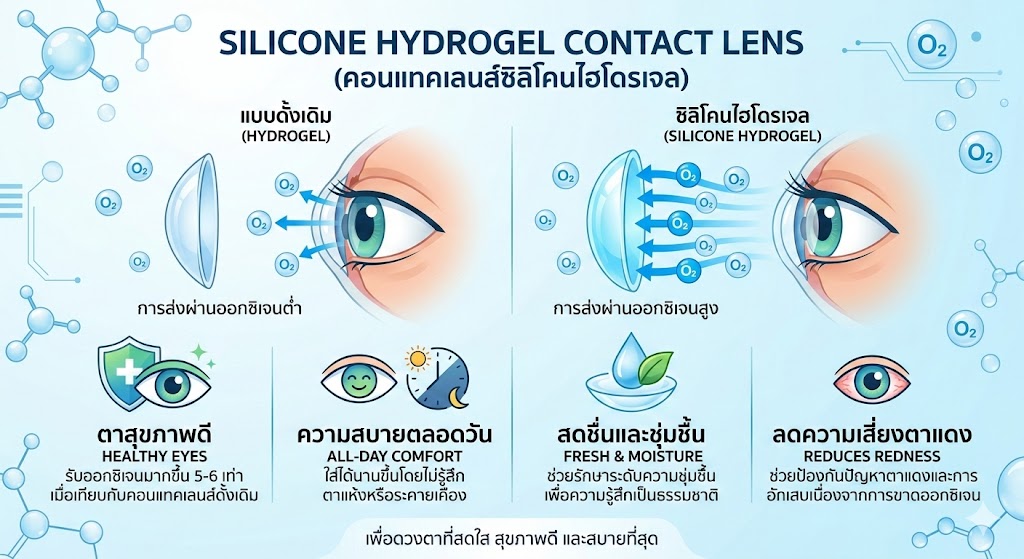
Why Is Oxygen Important for Your Eyes?
The cornea is an avascular tissue that receives oxygen directly from the atmosphere. When wearing contact lenses, oxygen transmission to the cornea is reduced. Insufficient oxygen can cause redness, dryness, and long-term corneal health issues.
What Is Silicone Hydrogel?
Silicone Hydrogel is a next-generation material that combines silicone with traditional hydrogel, resulting in lenses with oxygen transmissibility (Dk/t) values of 80-175 barrer/cm, compared to just 20-40 barrer/cm for conventional hydrogel lenses.
What Does Dk/t Mean?
Dk/t measures how much oxygen can pass through a contact lens:
- Dk = Oxygen permeability of the material
- t = Lens thickness
- Higher Dk/t = more oxygen reaches the cornea = healthier, more comfortable eyes
Holden & Mertz (1984) established that the minimum Dk/t required for daily wear is 24 barrer/cm — Silicone Hydrogel lenses exceed this threshold by 3-7x.
Benefits of Silicone Hydrogel in Glitzlens Lenses
- 5-8x more oxygen: Reduces risk of corneal hypoxia
- All-day comfort: Ideal for 8-12 hour wear
- Reduced dryness: Moisture-retaining structure
- Korean & Thai FDA Approved: International safety standards
Who Is It For?
Silicone Hydrogel is ideal for those who wear lenses all day long — office workers, students, or anyone spending extended time in air-conditioned environments. The material ensures your cornea receives adequate oxygen even during prolonged wear.
References
- Holden, B. A., & Mertz, G. W. (1984). Critical oxygen levels to avoid corneal edema for daily and extended wear contact lenses. Investigative Ophthalmology & Visual Science, 25(10), 1161-1167.
- Morgan, P. B., & Efron, N. (2009). The oxygen performance of contemporary hydrogel contact lenses. Contact Lens and Anterior Eye, 32(3), 95-99.
- Tighe, B. J. (2013). A decade of silicone hydrogel development: surface properties, mechanical properties, and ocular compatibility. Eye & Contact Lens, 39(1), 4-12.