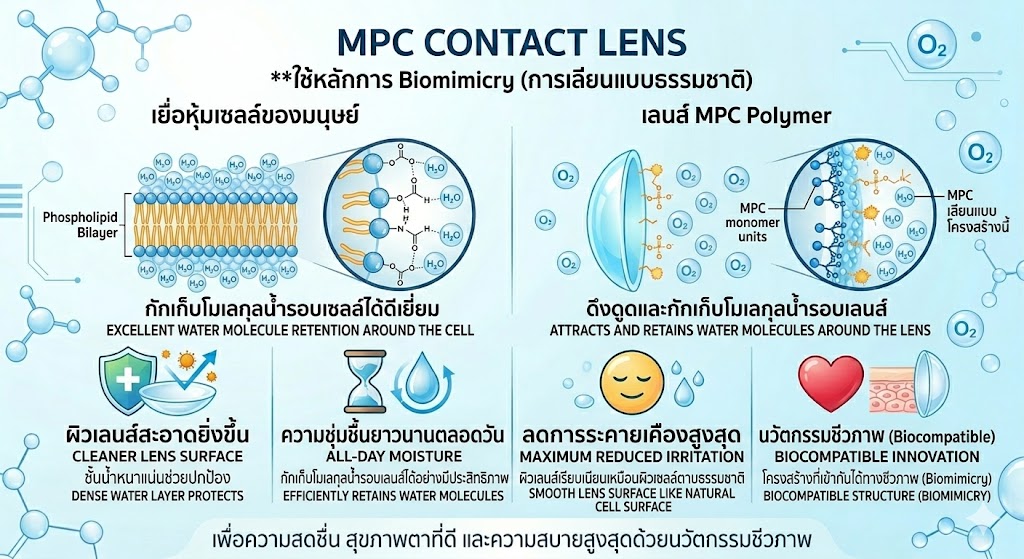
What Is MPC?
MPC (2-Methacryloyloxyethyl Phosphorylcholine) is a biocompatible polymer with a structure that mimics phospholipids — the primary component of human cell membranes. This technology was first developed by Professor Kazuhiko Ishihara at the University of Tokyo in 1998.
The Biomimicry Principle
Human cell membranes consist of a phospholipid bilayer that excels at retaining water. MPC polymer mimics this structure, enabling it to:
- Attract and retain water molecules around the lens surface
- Reduce protein and lipid deposits on the lens
- Maintain moisture longer than conventional moisturizers like Hyaluronic Acid
Research by Ishihara et al. (1998) demonstrated that MPC polymer exhibits exceptional biocompatibility because the body recognizes the phospholipid structure as "self."
UV Protection
In our digital age, we spend increasingly more time in front of screens. Glitzlens MPC Moisture Lock lenses have been tested by KOTI and feature excellent UV protection:
- 96% UV-B blocking: Reduces digital eye strain
- 87% UV-A blocking: Shields eyes from harmful UV radiation
Tosini et al. (2016) in Molecular Vision reported that prolonged blue light exposure can damage retinal cells and may be a risk factor for age-related macular degeneration (AMD).
Benefits of MPC Moisture Lock in Glitzlens Lenses
- Long-lasting moisture: Superior water retention vs Hyaluronic Acid
- Reduced deposits: Cleaner lens surface throughout the day
- 96% UV-B blocking: Protection from digital screens
- 80% UVA blocking: UV radiation protection
- High biocompatibility: Phospholipid structure minimizes irritation
Who Is It For?
MPC Moisture Lock is ideal for those who:
- Spend long hours on computers or phones
- Experience chronic dry eye symptoms
- Need UV protection for their eyes
- Work in screen-heavy environments — graphic designers, programmers, gamers
References
- Ishihara, K., et al. (1998). Hemocompatibility of human whole blood on polymers with a phospholipid polar group and its mechanism. Journal of Biomedical Materials Research, 41(3), 401-409.
- Tosini, G., Ferguson, I., & Tsubota, K. (2016). Effects of blue light on the circadian system and eye physiology. Molecular Vision, 22, 61-72.
- Feng, W., et al. (2006). Characterization of protein resistant MPC polymer surfaces. Biointerphases, 1(1), 50-60.
- Sheppard, A. L., & Wolffsohn, J. S. (2018). Digital eye strain: prevalence, measurement and amelioration. BMJ Open Ophthalmology, 3(1), e000146.